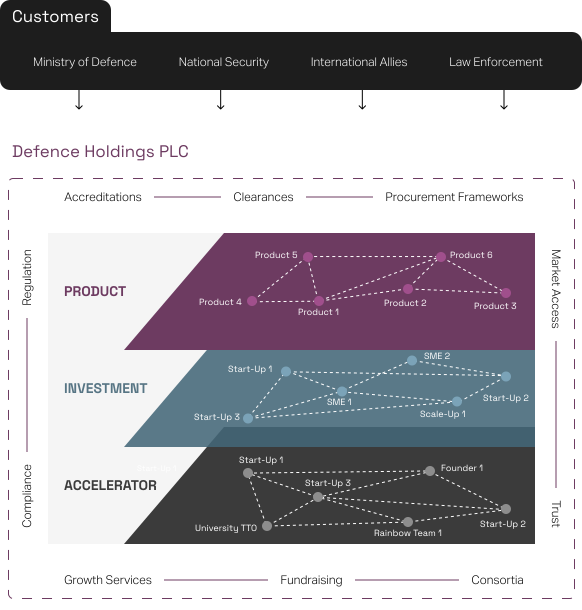
Operating Model.

Defence Holdings PLC is building the end-to-end platform for novel technology in European defence — combining customer intimacy, private capital, and hands-on innovation.
Listing
London Stock Exchange
Ticker
ALRT
Mandate
UK Pure-Play Defence
Accelerator Cohort One
Applications Open · 15 June 2026
The Moment

Why now matters.

The tectonic plates of European defence are shifting. The UK's role in the world, the alliances it must build, the conflicts it must be prepared for — all are being re-examined simultaneously. Budgets that were frozen for a generation are moving. The question is not whether defence will change. It already has.

But this is not about tanks, planes and warships alone. It is about digital presence. It is about making the unit of defence more affordable, more agile, and in some cases more disposable — something only the technology movement makes possible today. The convergence of software capability, accessible cloud infrastructure, and AI means that a FinTech company might unknowingly hold the answer to a digital targeting problem. The field of potential defence technology suppliers has never been wider.

At the same time, defence procurement has never been more broken. It is well admitted publicly: long sales cycles, bureaucratic processes, supply chains structured to work with established primes and disincentivised to work with agile companies. The machine will take time to fix. The private sector should not wait for it. The private sector should step up now — creating the pathways, solving the problems, demonstrating what is possible while the broader system catches up.

The Strategic Defence Review published in 2025 makes the direction of travel explicit. Three commitments define what the government needs from industry:

£2.5bn pa Increase in SME spend, year on year
10% of DE&S Budget directed at novel technology
£400m min UK Defence Innovation annual allocation

These are not aspirations. They are a mandate. And meeting that mandate requires a new kind of organisation — one that can be the trusted, sovereign, listed channel between government and the technology base it needs.

Value Proposition

Three forces.
One organisation.

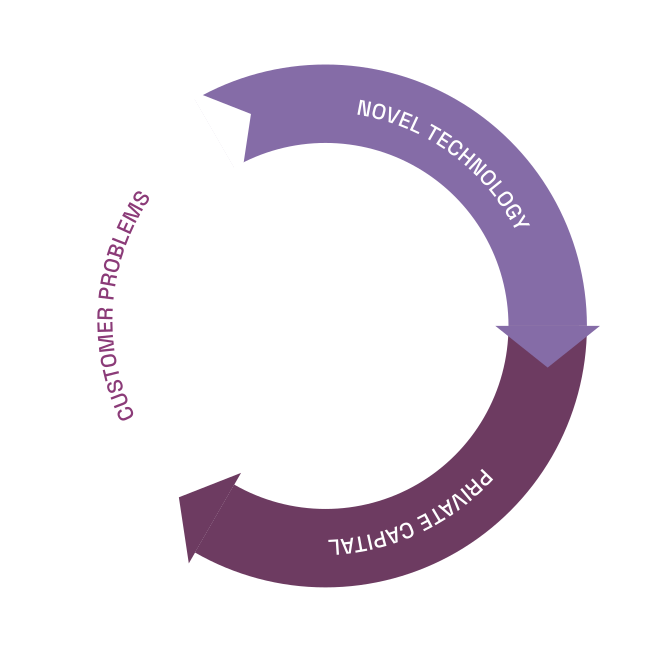
The bridge between customer problems and novel technology has been attempted before. What has never existed is a single sovereign organisation capable of bringing customer proximity, novel technology capability and deployable private capital together simultaneously.

01
Customer Problems

Close proximity to the problem book

We maintain the closest possible connection to how defence customers think, what they need, and how those needs evolve. Our executive team, our non-executive network, and our growing employee base stay at the customer's side — earning trust at every step, maintaining full situational awareness as the problem set iterates in real time.

02
Novel Technology

Intimacy with what technology can do

We track where emerging and deep technology intersects with the defence problem set. We know who the movers and shakers are. Where a solution exists, we find it. Where a gap exists between customer need and available technology, we build the solution ourselves — or we invest in the company that can.

03
Private Capital

Funded to move at the speed of the problem

We do not wait for a Ministry of Defence contract before we start working. Private capital allows us to deploy resource, prove capability, and build relationships on our own terms — then bring those proven solutions to market with confidence. We are motivated by the success of our investments and the resolution of the problems we are solving.

Our Playbook

Five steps.
One end-to-end model.

Defence Holdings is building a new kind of defence company. Our playbook combines five interlocking capabilities, from identifying the best early-stage technology companies to creating the infrastructure that allows them to succeed in a market that has historically kept them out. Each element reinforces the others. Together, they form an end-to-end model that no other listed vehicle in the European defence market can offer.

01
Identify & Attract

The Accelerator

This is not a generic accelerator. The market is full of programmes that offer a cohort experience, a thin layer of learning and development, and some advisory contact. We are not that. Our accelerator is hands-on, high-intensity, and commercially focused from day one.

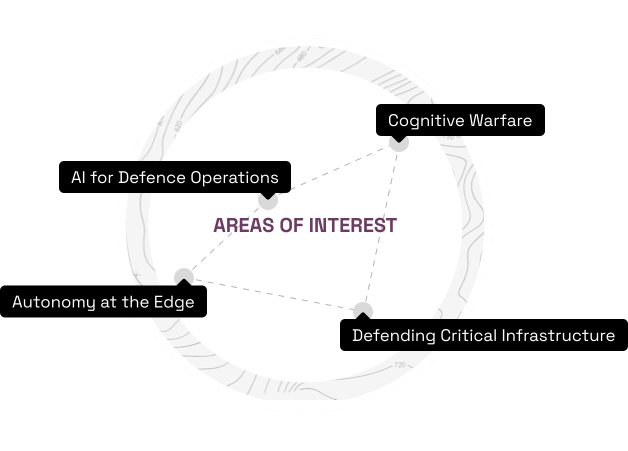
We issue a call to the best defence-relevant technology companies in the UK and those serving European markets — in the domains of defending critical infrastructure, cognitive warfare, autonomy at the edge, and AI for defence operations. We select ten companies per cohort. Then we transform their trajectory.

What that means in practice: a dedicated customer council reviews cohort products directly. We build product development roadmaps together and support them at every stage. We introduce active contracting opportunities along the way. We transform how cohort companies identify, pursue, and convert customer relationships. And we work on their investment roadmap, positioning each company for a credible fundraise within the programme period.

The sequencing is deliberate and important: customer first. Validate the product. Secure the first contract. Then go to the market to raise investment. We support the entire journey — including taking an equity position in companies where we participate.
02
Build a Portfolio

Invest in Novel Technology

We take equity positions in the best European defence technology companies. Our investment philosophy is straightforward: we are both intelligent capital and hands-on capital. We do not invest in a company and attend quarterly board meetings. We invest in a company's mission, buy into its capability, augment its team, and help it on its journey.

Investment takes three forms. First, we invest resources — expertise, access, introductions — free at the point of use, with commercial success converting to equity positions over an agreed period. Second, we invest directly and form joint ventures with organisations where a deeper partnership creates mutual value. Third, we act as the anchor tenant in a private fund alongside like-minded investors, acting as the exclusive investment pipeline into that fund — giving us the ability to deploy capital at much greater scale and ambition.

03
Own IP

Build Our Own Products

Where there is a clear customer demand signal but no available technology to meet it, we build the solution ourselves. Through our design and engineering studio, in partnership with Whitespace, we ideate, create proof of concepts, and develop design partnerships with customers — pulling through to contracted revenue, then scaling to additional customers.

We are currently developing three products. We know that some will fail, and we welcome that — the learnings, the customer feedback, and the relationships built in the process are real assets. We also forecast success from some, and we are building the mechanisms to capitalise on it. In due course, we will announce new products, new relationships, and first customer contracts.

We apply our own accelerator process to our products. If our methods are the right ones — and we believe they are — we should hold ourselves to the same standard as the companies we support.

04
Remove the Blockers

Create the Commercial Channel to Market

Defence procurement is notoriously difficult. Long sales cycles, bureaucratic processes, and a supply chain structurally disincentivised to work with young, agile companies. This is a real barrier that we cannot choose to ignore — and we do not intend to.

We are building a commercial channel that allows startups, scale-ups, SMEs, and our own products to navigate defence procurement — providing access to the things that have historically been completely out of reach at early stage: accreditations, frameworks, clearances, facilities, and team augmentation.

In partnership with IMSL, we offer a route through every barrier that stands between a capable company and a defence customer. This channel operates both inside the accelerator and outside of it — any company in our domains of interest can access it, subject to our assessment process. That assessment process is also how we identify future cohort companies, investment opportunities, and new capability for the portfolio.

The commercial logic is self-reinforcing: we don't need to spend money to solve this problem, because the marketplace solves it in itself. More commercial success for portfolio companies means growing equity value. Growing equity value means the whole model compounds.

05
The Destination — 2027+

Create the Technology Channel to Market

Looking beyond the near term, there is a larger prize. Today, hundreds of companies are building on platforms of their own choosing — each one facing an integration problem later, or a forced retooling when they secure a government contract. This is wasteful, slow, and avoidable.

We are building towards a connected, accredited, integrated technology platform — one that startups and scale-ups can build upon from day one, and that customers can trust to pull through to operational capability faster than would otherwise be possible. The platform serves both classified and unclassified environments, supports design and co-creation through to production, and connects coherently to hyperscalers, data platforms, integrators, and the major primes.

Because ultimately: if you want to get a product onto a Type 45 destroyer, you need to engage organisations like Thales. Building in isolation, without understanding the end-to-end delivery model embedded in the fleet, is not a solution. We are building the layer that makes the whole system work — from the startup's first prototype to the customer's operational deployment.

This is the 2027 and beyond story. Commercial success from this model begins to compound in that window. What we are doing now creates the infrastructure for that success.

Programme

The 2026/27
Accelerator Programme.

Applications open 15 June. Down-selection completes 25 June. Interviews take place 27 July. The first cohort commences 1 September and runs for twelve months.

We are targeting early-stage companies — bootstrapped, pre-seed, and those yet to raise their first round. Over the course of the programme, cohort companies receive equity investment, access to our product studio, target market assessment, direct customer access, and founder and CEO mentoring. On the commercial side, we work together on corporate strategy, fundraising, go-to-market planning, operational structuring, brand and marketing, dual-use exploitation, and a clear plan for securing growth.

Defence Holdings' own products go through the accelerator on exactly the same terms as every external company. We built this process because we believe it is the right one. We intend to prove it on ourselves first.

Projected dates
15 June 2026
Applications Open
Call to market. UK and European defence-technology companies apply across four domains of interest.
25 June 2026
Down-Selection
Applications reviewed. Shortlisted companies identified from across the applicant pool.
27 July 2026
Interviews
Shortlisted founders meet the team. Customer council and partners participate in assessment.
1 September 2026
Programme Commences
First cohort of up to ten companies begins the twelve-month programme. Concurrent NATO event announcement.
Early Stage
Boot-strapped
Pre-Seed

Programme consists of:

  • 10 companies (plus DH PLC products)
  • 12 months
  • Equity investment
  • Product studio
  • Target market assessment
  • Customer access
  • Founder/CEO mentoring
  • Corporate strategy
  • Fund-raising approach
  • Go-to-market plan
  • Operation structuring
  • Brand and marketing
  • Dual-use exploitation
  • Securing growth
Market Place

Create the Commercial
Channel to Market.

Defence and associated sectors have bought from large prime / tier 1 suppliers for a long time and for good reason. They are exceptionally good at delivering large, complex, high-risk programmes. Building an aircraft carrier requires structural competence and organisational depth that only established primes possess. Their strengths are real and enduring.

However, the defence ecosystem is changing rapidly. Traditional 10–15-year procurement cycles are no longer sufficient, and there is growing appetite for more agile, iterative capability delivery. Ukraine has demonstrated that we need to iterate faster, and different procurement modes are part and parcel of that shift.

The technology landscape has changed massively over the past decade. There's been a democratisation of technologies previously behind closed doors, making it easier to deliver more capability than was possible ten years ago. Dual-use contexts have shifted. Secure supply chains can now be established in ways that weren't previously possible.

For startups and scaleups, this creates unprecedented opportunities. The defence industry needs both primes and startups. Primes bring the organisational depth and risk management capabilities essential for complex systems. Startups bring innovation, agility, and fresh approaches to persistent problems.

The Strategic Defence Review suggests a simple approach to innovation procurement: Find it, Buy it, Use it. However, it is well documented that defence procurement is fundamentally broken. It is overly bureaucratic, risk averse and in need of transformation.

We think there is a pragmatic middle ground, the emergence of a sovereign, listed pure-play defence company that can be the trusted channel for defence to access technology and innovation whilst mitigating the risks in doing so.

Market Place

Create the Technology
Channel to Market.

Solving the commercial barriers to defence procurement is necessary. It is not sufficient.

The deeper problem is what happens when a capable product wins a contract but cannot be deployed, because it was built on the wrong platform, cannot integrate with existing systems, or cannot meet the classification requirements of the customer environment. This is where innovation stalls, and where the procurement process fails the customer it was designed to serve.

Defence Holdings is addressing this directly. Our fifth capability is the creation of a technology channel to market, an environment in which portfolio companies build on a connected, accredited and integrated platform from the outset, removing the integration challenge before it arises. Customers gain confidence in the deployability of what they are procuring. Companies gain a faster and more cost-effective route from product development to operational capability.

The platform spans design, test and production, operates across high and low classification environments, and connects to the hyperscalers, data platforms and AI models that underpin modern defence capability. It is architected to sit alongside, and work with, the primes and integrators who deliver complex programmes, not in competition with them.

The full commercial opportunity from this capability is a 2027 and beyond horizon. The architecture is established and the work is underway.

Market Place

In Practice.

The architecture described above is not a future state. This is how we expect our ecosystem to develop.

At the foundation, Defence Holdings anticipates connecting to the hyperscalers, neo-clouds and sovereign solutions — across providers such as AWS, Google, Oracle, Microsoft, Helsing and Nscale — that provide the infrastructure on which everything above runs. An orchestration operating system will coordinate the platform. Data platform capability will be anchored by providers of the calibre of Palantir and Faculty. AI model integration forms a critical part of the stack.

In the middle sit three distinct zones. Our native products — Durden, Ixian, Saga and others in development — are being built and iterated against live customer demand signals. A customer co-creation zone will enable grand challenges, design partnerships and rapid product build directly with end users. And the start-up zone will give accelerator and portfolio companies the demo environments, iteration support, integration capability, clearances, procurement frameworks and project management infrastructure to move from concept to contract.

Above that, the model anticipates working alongside the primes and integrators — organisations of the scale and capability of BAE Systems, QinetiQ, Lockheed Martin, Leidos, Thales, Babcock and Raytheon — to ensure that what Defence Holdings and its portfolio companies build can connect into the complex programmes that defence customers run. The end users are clear: Ministry of Defence, Army, Royal Air Force, Royal Navy.

The full commercial opportunity from this layer is a 2027 and beyond story. The foundations are being laid now.

Thesis

A roadmap and operating model to build the first open source prime.

The defence industry has primes. It does not have one built for the technology age. Defence Holdings is building the open-source prime, bringing together novel technology, private capital and deep customer relationships to create the channel that European defence has always needed.